10 Ways AI Can Make Your CRM Smarter and More Powerful
12 August 2026
Customer relationship management has evolved far beyond storing customer names, phone numbers, emails, and sales records. Modern businesses need their CRM systems to help them understand customers, automate repetitive work, identify opportunities, and make better decisions.
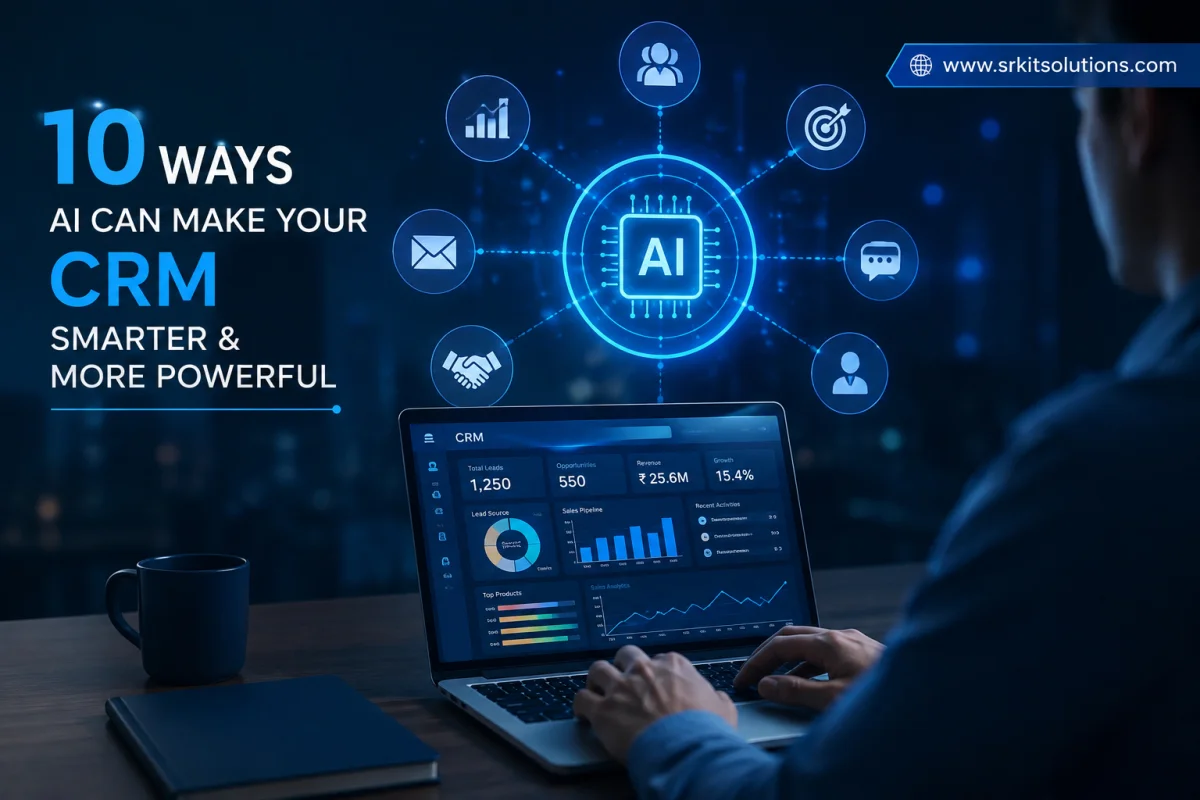
This is where Artificial Intelligence (AI) is changing the way businesses use CRM software.
An AI-powered CRM can analyze large amounts of customer data, identify patterns, automate routine tasks, and provide useful recommendations to sales and support teams.
For businesses considering a new CRM or planning to improve an existing system, AI can turn a traditional database into an intelligent business platform.
Here are 10 ways AI can make your CRM smarter and more powerful.
1. Automatically Identify and Prioritize Leads
Not every lead has the same potential.
Traditional CRM systems usually depend on sales teams to manually evaluate leads. AI can analyze customer information, previous interactions, enquiry details, website activity, purchase history, and other available data to identify which leads are more likely to convert.
An AI-powered lead scoring system can assign a score to each prospect and help sales teams focus their attention on high-value opportunities.
For example, a CRM could identify that a prospect who:
 Visited multiple product pages
- Downloaded a product brochure
- Requested pricing
- Responded to an email
- Previously interacted with the company
is more likely to become a customer than someone who simply submitted a basic enquiry.
This allows sales teams to spend more time on promising opportunities.
2. Automate Customer Follow-Ups
Following up with customers is essential, but manually tracking every follow-up can become difficult as a business grows.
AI can help CRM systems determine when a customer should be contacted and suggest the next action.
For example, the CRM could identify:
"This customer received a quotation five days ago but has not responded. A follow-up is recommended."
The system could then create a task for the salesperson or, where appropriate, trigger an automated message.
This reduces missed opportunities and helps businesses maintain consistent communication.
3. Generate Sales and Customer Insights
CRM systems contain valuable information, but collecting data is only the first step.
AI can analyze CRM data and turn it into meaningful insights.
Instead of manually studying hundreds of records, a manager could ask:
"Which products generated the most sales this quarter?"
or:
"Which customers have not purchased anything in the last six months?"
An AI-enabled CRM can analyze the available data and present the relevant information in an easier-to-understand format.
This can make business reporting faster and more accessible.
4. Predict Customer Behavior
One of the biggest advantages of AI is its ability to identify patterns.
By analyzing historical customer data, AI can help predict possible future behavior.
For example, an AI-enabled CRM could identify customers who may be:
- Ready for another purchase
- Interested in an upgrade
- At risk of leaving
- Likely to respond to a particular offer
- Suitable for a specific product or service
These predictions can help businesses take action before an opportunity is lost.
The goal is not simply to store what happened in the past, but to use historical information to make better decisions about what could happen next.
5. Improve Customer Support
AI can also make CRM systems more useful for customer service teams.
An AI assistant can help support staff find relevant customer information quickly, summarize previous conversations, and suggest possible responses.
For example, when a customer contacts support, the CRM could show:
- Customer details
- Previous purchases
- Previous support requests
- Recent conversations
- Open issues
- Relevant account information
An AI assistant could then summarize the customer's history so the support employee doesn't have to search through multiple records.
This can improve response times while giving customers a more personalized experience.
6. Create Personalized Customer Experiences
Customers increasingly expect businesses to understand their needs.
AI can help CRM systems personalize customer interactions based on available customer data.
Instead of sending the same message to every customer, businesses can use AI to identify relevant products, services, offers, or content.
For example, an online business could identify customers interested in a particular product category and create targeted campaigns for them.
Personalization can make communication more relevant and potentially improve engagement.
7. Reduce Manual Data Entry
Sales and support teams often spend significant amounts of time updating CRM records.
AI can help reduce this administrative workload.
Depending on the CRM architecture and integrations, AI can assist with tasks such as:
- Summarizing conversations
- Extracting information from messages
- Categorizing leads
- Creating follow-up tasks
- Updating customer records
- Generating meeting summaries
- Classifying support requests
Reducing repetitive administrative work allows employees to spend more time interacting with customers and generating business.
8. Turn Conversations Into Useful CRM Data
Businesses communicate with customers through many channels, including email, chat, forms, phone calls, and messaging platforms.
Important information can easily become buried inside these conversations.
AI can process conversations and extract useful information.
For example, after a sales meeting, AI could help generate a summary containing:
Customer requirement: Website and mobile application
Estimated budget: ₹5 lakh
Expected timeline: 3 months
Next action: Send technical proposal
This information can then be used by the CRM to maintain a more complete customer record.
For organizations handling hundreds or thousands of customer conversations, this capability can be particularly valuable.
9. Provide Intelligent Sales Recommendations
AI can help sales teams determine what action to take next.
For example, based on customer history, the CRM might identify that a customer who purchased a particular service is a potential candidate for another related service.
An AI-powered CRM could provide recommendations such as:
- Follow up with this lead
- Contact this inactive customer
- Recommend a related product
- Schedule a renewal reminder
- Escalate this support issue
- Prioritize this opportunity
Instead of requiring employees to manually analyze every customer record, the CRM can act as an intelligent assistant.
10. Give Business Owners an AI Assistant for Their CRM
Perhaps one of the most interesting developments is the ability to interact with CRM data using natural language.
Instead of navigating through multiple reports, a business owner could ask:
"Show me this month's highest-value customers."
or:
"Which leads have been waiting for a response for more than three days?"
or:
"What is the total sales value by salesperson?"
An AI assistant can interpret the question, retrieve relevant CRM information, and present the result in a simple format.
This makes complex business data easier to access, even for users who are not technically experienced.
AI Doesn't Replace CRM — It Makes CRM More Intelligent
AI should not be viewed as a replacement for CRM software.
Instead, AI can make the existing CRM significantly more useful.
A traditional CRM primarily answers:
"What happened?"
An intelligent CRM can help answer:
"What is happening?"
and potentially:
"What should we do next?"
That shift can make a major difference for sales, marketing, customer service, and management teams.
What Should an AI-Powered CRM Include?
Businesses don't necessarily need every possible AI feature.
The right features depend on the organization's workflow, customer volume, industry, and goals.
A practical AI CRM implementation might include:
- AI lead scoring
- Automated follow-ups
- Customer segmentation
- AI-powered search
- Conversation summaries
- Predictive analytics
- Sales recommendations
- Customer support assistance
- AI chatbot integration
- Automated reporting
- Natural-language CRM queries
- Workflow automation
The most important factor is integrating AI into real business processes rather than adding AI simply because it is a popular technology.
Building a Custom AI CRM for Your Business
Every business manages customers differently.
A CRM designed for a real estate company may need completely different workflows from one designed for a software company, educational institution, healthcare organization, or service provider.
A custom CRM can be designed around the organization's actual processes.
At SRK IT Solutions, we develop business applications using modern technologies such as Symfony, API Platform, React, Next.js, and cloud services. These technologies can be combined with AI capabilities to create CRM platforms that fit specific business requirements.
A custom solution can integrate:
- CRM and sales management
- Customer databases
- Lead management
- Automated workflows
- Email and messaging
- Reporting and dashboards
- AI assistants
- Document processing
- Third-party APIs
- Cloud infrastructure
- Role-based access control
This approach allows businesses to start with the features they actually need and expand the platform as the organization grows.
The Future of CRM Is Intelligent
CRM software is moving from being a simple customer database toward becoming an intelligent business assistant.
AI can help businesses understand customers better, automate repetitive processes, prioritize opportunities, improve customer service, and make faster decisions.
However, successful AI adoption is not about adding as many AI features as possible.
It is about identifying where intelligence and automation can create measurable business value.
For businesses planning their next CRM system, now is a good time to consider how AI can become part of the overall architecture rather than being added as an afterthought.
Looking to Build an AI-Powered CRM?
If your business needs a custom CRM with AI, automation, analytics, and integrations, SRK IT Solutions can help design and develop a solution around your business workflow.
From CRM development and API development to modern React/Next.js applications and cloud deployment, we can help turn your CRM requirements into a scalable business application.
SRK IT Solutions — Building smarter business software with modern technology and AI.
Blog Categories